
Getting Ready to Rent
A plain-English guide to the legal requirements for letting a property in England. Each section explains what's needed, why, and what happens if you don't comply.
The visual guide
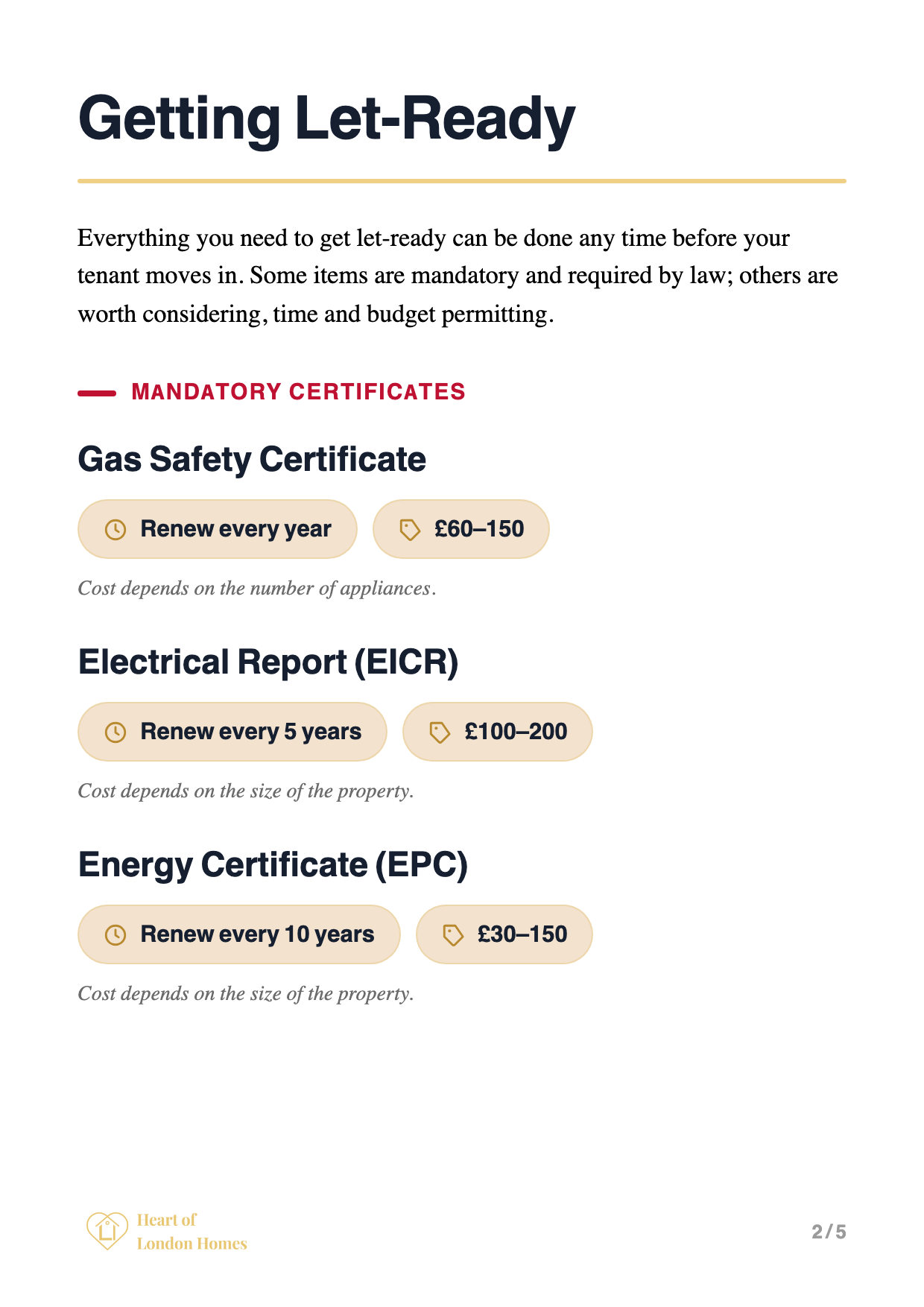
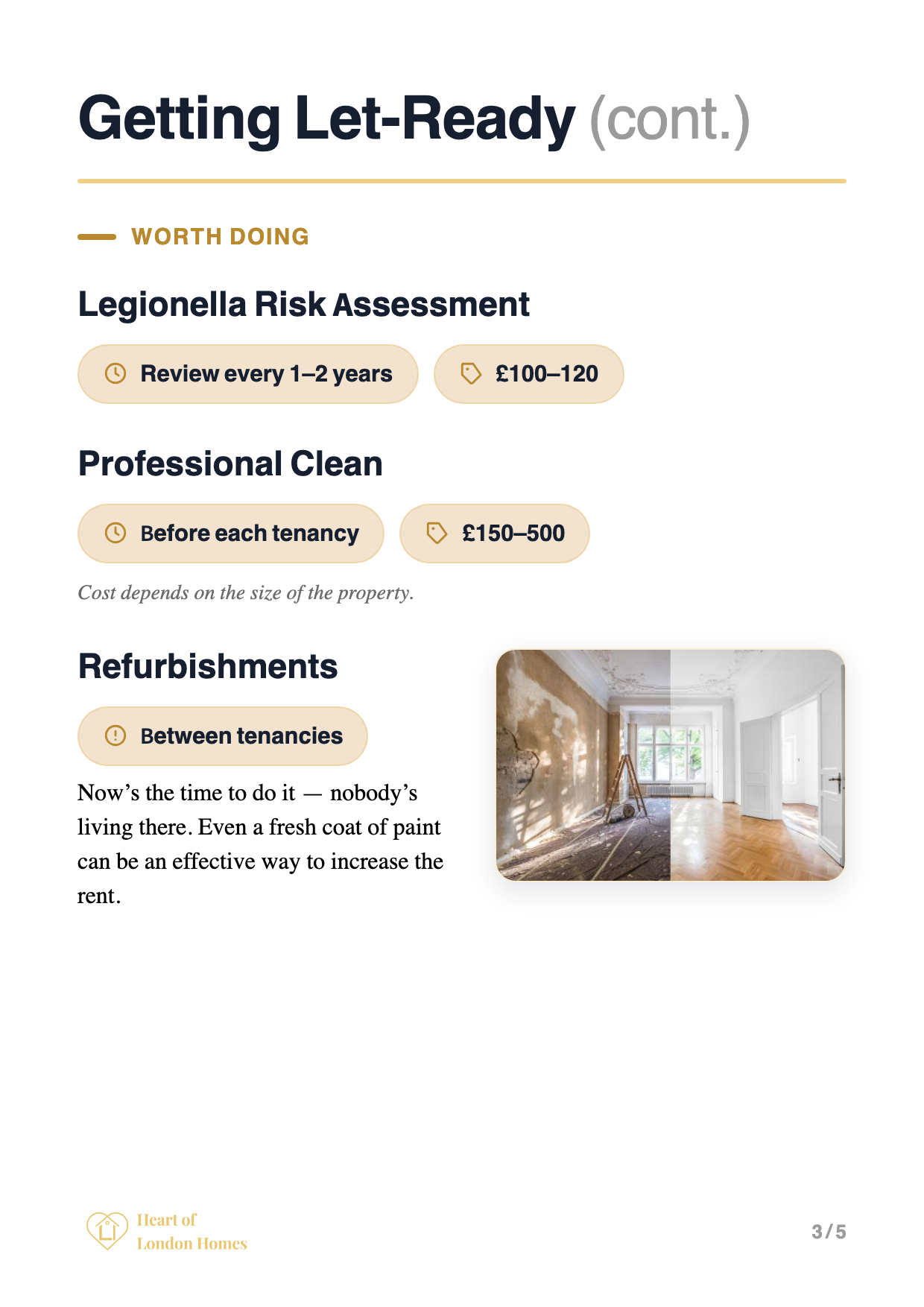
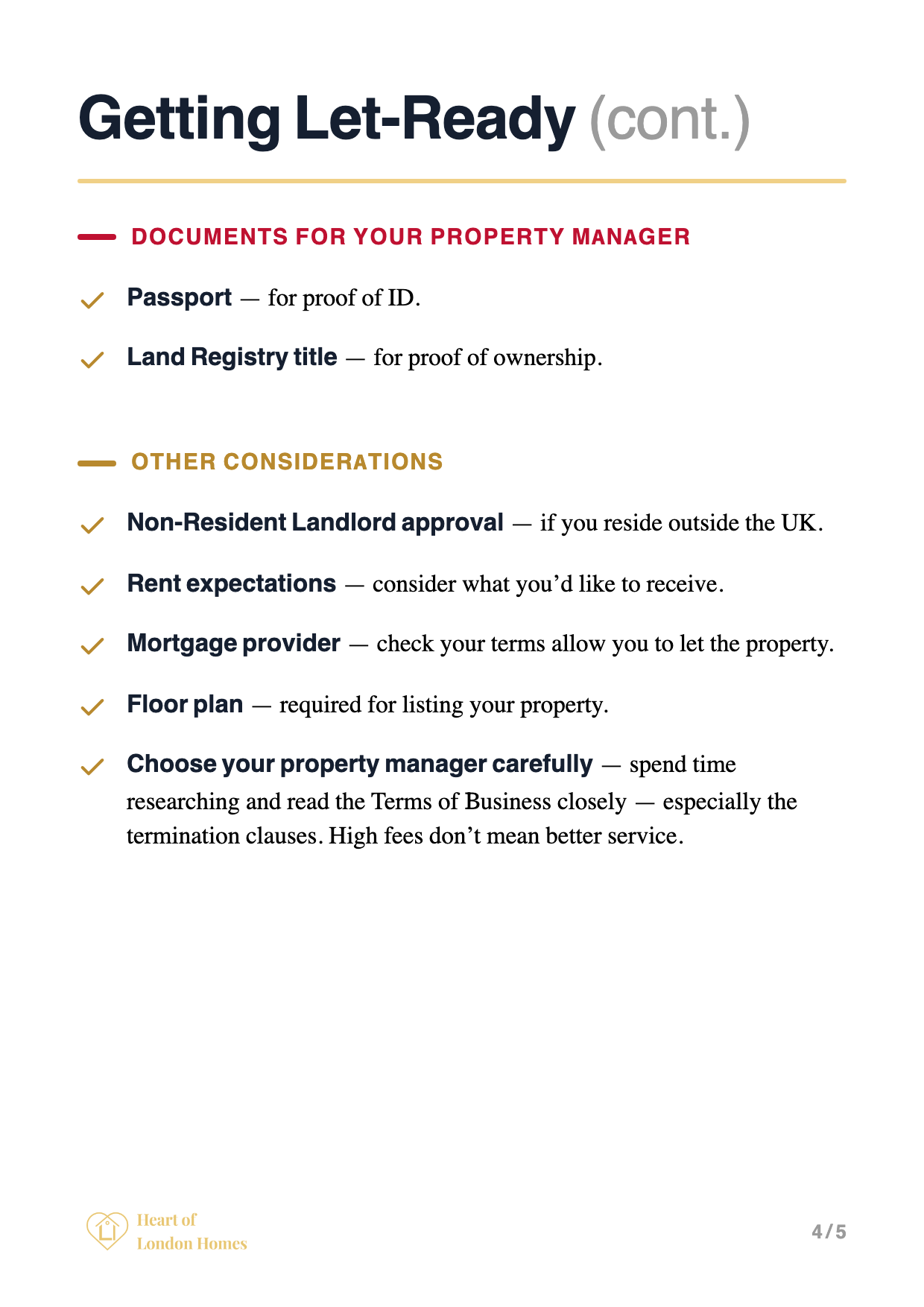
Swipe through every let-ready essential — mandatory certificates, the jobs worth doing, and what your property manager needs.
1 of 5

Every requirement, in detail
What each one is, why it's required, and how we get it sorted.
1. Gas Safety Certificate
What it is
An annual safety check of all gas appliances, fittings, and flues in the property, carried out by a Gas Safe registered engineer.
Why it's required
It's a legal requirement under the Gas Safety (Installation and Use) Regulations 1998. You must provide a copy of the gas safety record to tenants within 28 days of the check, or before they move in. Failure to comply is a criminal offence — penalties include unlimited fines and up to six months in prison.
How we get this sorted
Book an annual gas safety check with a Gas Safe registered engineer. Keep the certificate and upload it to your dashboard. The check must be renewed every 12 months.
2. EICR (Electrical Installation Condition Report)
What it is
A report on the condition of the electrical installation in the property, carried out by a qualified electrician.
Why it's required
Required since July 2020 under the Electrical Safety Standards in the Private Rented Sector (England) Regulations 2020. An EICR must be carried out every 5 years, or more frequently if the report recommends it. Local authorities can impose fines of up to £30,000 for non-compliance.
How we get this sorted
Have the electrical installation inspected by a qualified electrician. Any urgent remedial work (Code 1 or Code 2) must be completed within 28 days. Upload the EICR to your dashboard.
3. EPC (Energy Performance Certificate)
What it is
A certificate rating the energy efficiency of the property from A (most efficient) to G (least efficient), valid for 10 years.
Why it's required
Under the Minimum Energy Efficiency Standards (MEES), rental properties in England must have a minimum EPC rating of E. You need a valid EPC before marketing the property. Letting a property with an F or G rating can result in fines of up to £5,000. The government has proposed raising the minimum to C for new tenancies — check GOV.UK for the latest position.
How we get this sorted
Commission an EPC from an accredited energy assessor. If the rating is below E, you'll need to make improvements before letting. Upload the certificate to your dashboard.
4. Smoke Alarms
What it is
Working smoke alarms installed on every storey of the property that is used as living accommodation.
Why it's required
Required under the Smoke and Carbon Monoxide Alarm (Amendment) Regulations 2022. Landlords must ensure alarms are installed and test them on the day a new tenancy begins. Local authorities can impose fines of up to £5,000 for non-compliance.
How we get this sorted
Install at least one smoke alarm on every storey used as living accommodation. Test all alarms at the start of each new tenancy. Replace batteries or faulty units promptly.
5. Carbon Monoxide Alarms
What it is
A carbon monoxide alarm in any room containing a fixed combustion appliance (gas boiler, gas fire, wood-burning stove, etc.).
Why it's required
Required under the Smoke and Carbon Monoxide Alarm (Amendment) Regulations 2022. From October 2022, this was extended to include all rooms with gas appliances (previously only solid fuel). Carbon monoxide is odourless and can be fatal — alarms are a critical safety measure.
How we get this sorted
Install a carbon monoxide alarm in every room with a fixed combustion appliance. Test alarms at the start of each tenancy. Replace alarms according to the manufacturer's instructions (typically every 5-7 years).
6. Legionella Risk Assessment
What it is
An assessment of the risk of legionella bacteria in the property's water systems, including hot and cold water tanks, pipes, and showers.
Why it's required
The Health and Safety Executive (HSE) requires landlords to assess and control the risk of legionella in their properties. While there's no specific fine for not having an assessment, landlords have a duty of care under the Health and Safety at Work Act 1974. If a tenant contracts Legionnaires' disease, the landlord could face prosecution.
How we get this sorted
Have a legionella risk assessment carried out and review it every two years. Practical steps include flushing water systems if the property has been empty, ensuring hot water is stored at 60°C, and keeping cold water below 20°C.
7. Landlord Insurance
What it is
Specialist insurance covering buildings, contents (if furnished), and landlord liability for a rental property.
Why it's required
Standard home insurance policies typically don't cover rental properties. Most mortgage lenders require landlord-specific buildings insurance as a condition of a buy-to-let mortgage. Landlord liability cover protects you if a tenant or visitor is injured at the property due to a maintenance issue.
How we get this sorted
Take out a landlord insurance policy covering buildings and liability as a minimum. Check your mortgage terms for specific requirements. Upload proof of cover to your dashboard.
8. Property Licence
What it is
A licence from the local council permitting the property to be let. There are three types: mandatory HMO licensing, additional licensing, and selective licensing.
Why it's required
Mandatory HMO licensing applies to properties with 5 or more tenants from 2 or more households. Many London boroughs also run additional or selective licensing schemes covering smaller HMOs or all private rentals in certain areas. Operating without a required licence is a criminal offence with fines of up to £30,000, and tenants can claim back up to 12 months' rent.
How we get this sorted
Check with your local council whether your property requires a licence. Apply before letting if one is needed. Licences typically last 5 years and come with conditions about property standards and management.
9. Furniture and Furnishings Fire Safety
What it is
Fire resistance standards for upholstered furniture provided in a furnished or part-furnished rental property.
Why it's required
The Furniture and Furnishings (Fire Safety) Regulations 1988 (as amended) require all upholstered furniture in rental properties to meet fire resistance standards. This includes sofas, beds, mattresses, cushions, and pillows. Items must carry a permanent label confirming compliance. Supplying non-compliant furniture is a criminal offence.
How we get this sorted
Check that all upholstered furniture has fire-resistance labels. Remove and replace any items without labels or that pre-date the regulations. This doesn't apply to unfurnished lettings or to antique furniture made before 1950.
10. Emergency Contact Information
What it is
A set of emergency contact numbers and instructions provided to tenants for use in case of urgent issues at the property.
Why it's required
While not a strict legal requirement, providing emergency contacts is best practice and expected by most tenancy agreements. Tenants need to know who to call for gas leaks (National Gas Emergency Service), water leaks, electrical faults, and general property emergencies. It reduces response times and helps prevent damage.
How we get this sorted
Provide tenants with emergency numbers for gas (0800 111 999), water (your local supplier), electricity (105), and your managing agent or landlord contact. Leave a printed copy at the property.
11. Right to Rent Checks
What it is
A check to verify that prospective tenants have the legal right to rent residential property in England.
Why it's required
Required under the Immigration Act 2014 (England only). Landlords must check that all adult occupiers have the right to rent before the tenancy starts. Checks must be repeated for tenants with time-limited immigration status. Civil penalties for non-compliance start at £5,000 per tenant for a first offence and up to £10,000 for repeat offences. Knowingly renting to someone without the right to rent is a criminal offence.
How we get this sorted
Check original identity documents (passport, biometric residence permit) for all adult occupiers before the tenancy starts. Keep copies for at least one year after the tenancy ends. You can also use the Home Office online checking service.
12. Deposit Protection
What it is
Protection of the tenant's security deposit in a government-approved tenancy deposit scheme within 30 days of receiving it.
Why it's required
Required under the Housing Act 2004 for all assured shorthold tenancies. There are three government-approved schemes: DPS, MyDeposits, and TDS. If you don't protect the deposit within 30 days, you cannot serve a valid Section 21 notice, and a court can order you to pay the tenant compensation of up to 3 times the deposit amount.
How we get this sorted
Register the deposit with an approved scheme within 30 days. Provide the tenant with the scheme's prescribed information within the same period. Keep proof of protection for the duration of the tenancy.
13. How to Rent Guide
What it is
A government-published checklist for tenants explaining their rights and responsibilities. The latest version is available on GOV.UK.
Why it's required
Landlords in England must provide tenants with the most up-to-date version of the "How to Rent" guide at the start of each new tenancy. Failure to do so means you cannot serve a valid Section 21 notice. It's a simple requirement but easily overlooked.
How we get this sorted
Download the latest version from GOV.UK and provide it to your tenant (email is fine) before or at the start of the tenancy. Check for updates before each new tenancy, as the guide is revised periodically.
14. Landlord ID
What it is
Valid photographic identification — a passport or driving licence — to verify your identity as the property owner.
Why it's required
Anti-money laundering (AML) and know-your-customer (KYC) regulations require letting agents and property managers to verify the identity of landlords they work with. This is a legal obligation under the Money Laundering Regulations 2017, which apply to estate and letting agents.
How we get this sorted
Upload a clear copy of your valid passport or driving licence to your dashboard. We'll verify it as part of the onboarding process.
15. Proof of Ownership
What it is
Documentation proving you own the property — typically a Land Registry title document or a recent mortgage statement.
Why it's required
Letting agents and property managers need to confirm that you are the legal owner (or have the owner's authority) before managing a property on your behalf. This is part of due diligence requirements and protects both you and the tenant from fraudulent lettings.
How we get this sorted
Upload a copy of your Land Registry title document (available from HM Land Registry for a small fee) or a recent mortgage statement showing the property address. We'll verify it during onboarding.
16. PAT (Portable Appliance Testing)
What it is
A check of the portable electrical appliances you provide with the property — things like a kettle, microwave, lamp, or washing machine — confirming they're safe to use.
Why we ask
PAT is not a legal requirement for rental properties, but landlords have a general duty under the Electrical Equipment (Safety) Regulations 1994 to ensure appliances they supply are safe. Many landlords arrange PAT as good practice — it's a simple way to evidence that the appliances you provide have been tested, and it reassures tenants. If you don't supply any portable appliances, this doesn't apply to you.
How we get this sorted
If you provide portable appliances, have them tested by a competent person and upload the report to your dashboard. Testing is commonly repeated annually. If you don't provide any appliances, mark this item "Not applicable".
Compliance is complex — we make it simple.
This information is adapted from GOV.UK, licensed under the Open Government Licence v3.0.